Loading
By Latha Kumaresan · DirectorReviewed 23 September 2026
Why this exists
What this group covers
pipelines & stages · deal records · weighted forecasting · deal splits · win/loss reasonsPipelines with stages you define, entry criteria that must be satisfied before a deal can advance, deal records that keep every change to value, owner and close date, and weighted forecasting that shows the unweighted number beside it.
Alongside those sit the parts that make the rest legible: splits for deals with more than one owner, required win/loss reasons at close, readable scoring rules, and automation that fires on a stage change rather than on somebody remembering.
What it does
What changes when the pipeline is on the shared record
Because a pipeline starts as a shared language and ends as a filing convention. Stage names drift until two reps mean different things by "negotiation", probability is set once and never revisited, and close dates slide a fortnight at a time in increments too small for anyone to flag.
By the time the quarter is obviously wrong, the pipeline has been wrong for two months. Nobody can point at when it started, because nothing recorded the moment it did.
A stage change stops being an update to a sales system. Reaching Won opens delivery phases in Loop from the sold lines and a billing schedule in Books from the agreed terms, without a handover meeting and without anybody re-keying the sale.
It also means the forecast is arithmetic over rows the whole company can see. When a number is disputed, it can be opened to the deals underneath it, which usually ends the dispute faster than defending it does.
Pipelines & stages
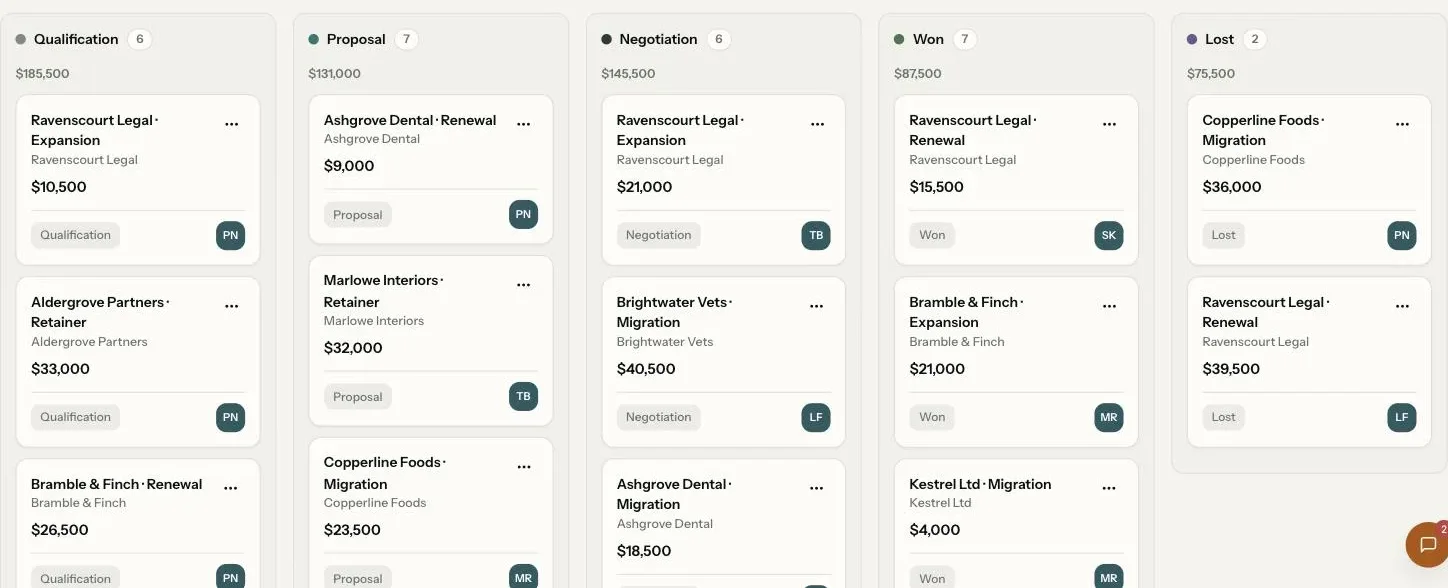
A pipeline is an ordered set of stages a deal moves through, each with entry criteria you write, so a stage is a statement about the deal rather than a label on a card.
Deal records
The deal is the record of one opportunity: value, currency, owner, stage, close date, the company and contacts attached to it, and the full history of how each of those changed.
Weighted forecasting
Weighted forecasting multiplies each open deal by the probability of its stage and totals the result, showing that figure alongside the unweighted pipeline it came from.
Deal splits
A split divides credit for one deal between named people by percentage, on the deal record, with each share visible to reporting and to the people it names.
Win/loss reasons
A win/loss reason is a structured value chosen from a list you define, required before a deal can be marked won or lost, with optional free text beside it.
Deal scoring
Deal scoring applies rules you write to open deals — stage age, activity recency, whether a budget holder is named — and shows the score with the rules that produced it.
Multiple pipelines
Separate pipelines for separate sales motions — new business, renewals, partner-sourced — each with its own stages, probabilities and required fields, all reading the same customer records underneath.
Stage automation
Stage automation runs a defined action when a deal enters or leaves a stage: create a task, draft a quote, notify a person, open a Loop phase or raise a flag for review.
In practice
What the pipeline won't do
It will not stop a determined rep advancing a deal by filling in a field. Entry criteria make the claim explicit and auditable; they do not make it true, and a team that games them will produce a pipeline that is precisely and confidently wrong.
Nor will it price the work. What a deal is worth to you lives here; what it costs to deliver lives in Loop and Books, and margin is the comparison of the two.
What it does not do
Start with the stages you actually run rather than the ones a template suggests, and give each one entry criteria you are willing to enforce. A stage with no criteria is a label, and labels are what produced the forecast you are trying to replace.
Set probabilities per pipeline, not globally — a renewal at 60% and a new logo at 60% are not the same bet, and treating them alike is the most common reason a weighted forecast reads badly.
How it connects
See the Flow journeys →Who else reads the pipeline
Loop opens delivery from won deals and reports variance against what was sold. Books bills from the terms and recognises the revenue. Desk sees account standing when it prioritises a ticket. Growth follows the campaign that produced the lead through to the closed number. Each reads the same deal row. None of them keeps a second copy, which is why they cannot quietly disagree about what was sold.
Setting it up
Flow · Moving your pipeline in takes four days.Day 1Decide the stagesBefore any import. Stage names are the one thing here that is genuinely painful to change in month three.
Day 2Import into a sandboxDeals, contacts and three years of closed history, mapped and checked before anybody logs in.
Day 3Wire the routingForms, inbox and owner rules, so a new lead lands on a person rather than in a queue nobody reads.
Day 4Let the team inSales first, then whoever reads the forecast. The old CRM stays readable for a month.
What does it change?
A stage change stops being an update to a sales system. Reaching Won opens delivery phases in Loop from the sold lines and a billing schedule in Books from the agreed terms, without a handover meeting and without anybody re-keying the sale.
What does it not do?
It will not stop a determined rep advancing a deal by filling in a field. Entry criteria make the claim explicit and auditable; they do not make it true, and a team that games them will produce a pipeline that is precisely and confidently wrong.
How do we set it up?
Start with the stages you actually run rather than the ones a template suggests, and give each one entry criteria you are willing to enforce. A stage with no criteria is a label, and labels are what produced the forecast you are trying to replace.
The other Flow areas
Full feature list →RecordsContacts & companiesOne company row the whole platform reads, including the unglamorous parts — duplicates, subsidiaries and who has actually consented to be emailed.Feature areaQuoting & proposalsFeature areaActivity & communicationIntakeLead capture & routingFeature areaReporting & forecastFeature areaAdmin & extensibility
Easier to see Pipeline & deals running on your own records than to read about it.
Fourteen days, every module, no card. Or half an hour with someone who will run it on your own records and tell you where it does not help.