Loading
By Latha Kumaresan · DirectorReviewed 23 September 2026
In short
What is quoting and proposal management in a CRM?
Quoting and proposals covers building a priced quote from your catalogue, getting discounts approved, generating the proposal document, collecting signatures and tracking versions. In Treepie Flow quotes are priced from the rate card finance maintains in Books, discounts past a threshold route to a named approver, and an accepted quote becomes the delivery plan in Loop and the billing schedule in Books.
- Priced from
- Rate cards per customer, currency and term
- Approvals
- Discounts past your threshold go to a named approver
- Signature
- Sent, tracked and countersigned from the deal
- After acceptance
- Loop delivery phases and a Books billing schedule
Why this exists
What this group covers
quote builder · rate cards · discount approvals · proposal templates · e-signatureA quote builder that prices line items from the catalogue Books maintains, rate cards per client, currency and term with effective dates, discount thresholds routed to a named approver, proposal templates that resolve fields from the record, e-signature against the deal, and full version history.
When a quote is accepted it opens delivery in Loop and billing in Books from the same lines, so the accepted document is the specification rather than a summary of one.
What it does
What changes when quoting reads finance's numbers
Because sales quotes from a copy of the price list and finance bills from the real one. The copy is a spreadsheet, or a template, or a rep's memory of what was agreed last time, and it is accurate right up until the quarter prices changed.
The gap surfaces at invoicing, weeks after the customer has formed a view about what they are paying. It is then resolved by whoever is least willing to argue, which is rarely the outcome that protects the margin.
A rep cannot select an out-of-date price, because there is no second price list to select from. Discounts past a threshold reach an approver with the delivery cost attached, so the decision is made against margin rather than against enthusiasm.
And the executed contract lives on the deal. Two years later a scope dispute is settled from the record — the signed document, the version history showing what changed, and the date the customer agreed it.
Quote builder
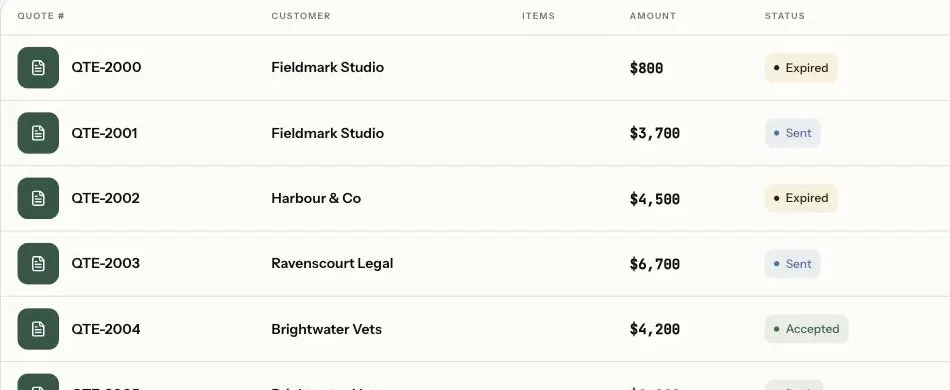
The quote builder assembles line items from the product and service catalogue Books maintains, applies the rate card that governs this customer, and produces a priced document attached to the deal.
Rate cards
A rate card is a set of prices that applies to a customer, currency and contract term, with an effective date — so pricing is a record with a history rather than a current state.
Discount approvals
Discount approval routes any quote past a threshold you define to a named approver, records their decision with the reason given, and keeps both on the deal.
Proposal templates
A proposal template is a set of reusable sections that pull values from the deal, the company and the quote when the document is generated.
E-signature
E-signature sends the proposal or contract for signature from the deal, tracks its state, collects the countersignature and stores the executed document against the record.
Version history
Every issued quote or proposal is kept as a version, with a diff against the one before it, the person who made the change and the reason recorded against it.
Quote to order
When a quote is accepted, its sold lines become the basis for delivery phases in Loop and a billing schedule in Books, both pointing back at the quote rather than copying it.
In practice
What quoting won't do
It will not invent a price for something that is not in the catalogue. Genuinely bespoke lines are entered explicitly and flagged, so finance sees them before they become a commitment rather than afterwards.
And Treepie records the signing process and keeps the evidence; whether a given signature is binding in your jurisdiction is a question for your own advisers, not a claim this page makes.
What it does not do
Get the catalogue and rate cards into Books first. Quoting reads them, so a quote builder pointed at an incomplete catalogue reproduces exactly the problem it was meant to remove.
Then set discount thresholds low enough that they are used and high enough that they are not theatre. A threshold everyone routes around teaches the team that approvals are a formality.
How it connects
See the Flow journeys →Who else reads quotes
Books owns the catalogue and the rate cards, bills from the accepted version and recognises revenue against it. Loop opens delivery phases from the sold lines and reports variance when delivery differs from what was sold. Pipeline reports read quote values, and cohort analysis reads the rate card that applied when the deal started rather than the one in force today.
Setting it up
Flow · Moving your pipeline in takes four days.Day 1Decide the stagesBefore any import. Stage names are the one thing here that is genuinely painful to change in month three.
Day 2Import into a sandboxDeals, contacts and three years of closed history, mapped and checked before anybody logs in.
Day 3Wire the routingForms, inbox and owner rules, so a new lead lands on a person rather than in a queue nobody reads.
Day 4Let the team inSales first, then whoever reads the forecast. The old CRM stays readable for a month.
Who it is for
Quotes that sales, finance and delivery all agree with.
Account executivesBuild a correct quote in minutes and send it for signature from the deal.“Can I offer 12% on this one?”
Sales managers & approversApprove discounts with the deal context and margin in front of them.“Why does this quote need 15%?”
FinanceKnow every quote uses the current price list and agreed terms.“What rate card was this priced from?”
DeliveryReceive the sold lines as project phases, not a PDF to interpret.“What exactly did we sell Halstead?”
Quoting a deal, three ways.
| Documents & spreadsheets | Standalone quoting tool | Treepie Flow | |
|---|---|---|---|
| Prices | Copied from an old quote | A separate price list to maintain | The rate card finance owns |
| Discount approval | An email thread | Workflow in another tool | Routed on the deal, decision recorded |
| Versions | Final_v3_REAL.docx | Kept in the tool | Every version, with a diff and reason |
| Signature | Print, sign, scan | Separate e-signature tool | Sent and tracked from the deal |
| After acceptance | Retyped into projects and invoices | Exported | Becomes the project and billing schedule |
What does it change?
A rep cannot select an out-of-date price, because there is no second price list to select from. Discounts past a threshold reach an approver with the delivery cost attached, so the decision is made against margin rather than against enthusiasm.
What does it not do?
It will not invent a price for something that is not in the catalogue. Genuinely bespoke lines are entered explicitly and flagged, so finance sees them before they become a commitment rather than afterwards.
How do we set it up?
Get the catalogue and rate cards into Books first. Quoting reads them, so a quote builder pointed at an incomplete catalogue reproduces exactly the problem it was meant to remove.
Where do quote prices come from?
From rate cards maintained in Books, per customer, currency and term, each with an effective date.
How do discount approvals work?
Quotes past your threshold route to a named approver, who sees the deal and margin; the decision and reason stay on the deal.
Is e-signature included?
Yes. Send for signature from the deal, track it, collect the countersignature and store the executed document.
Can we use our own proposal templates?
Yes. Reusable sections pull values from the deal, company and quote when the document is generated.
Are quote versions kept?
Every issued quote is kept as a version, with a diff, the person who changed it and why.
What happens when a quote is accepted?
Accepted lines become Loop delivery phases and a Books billing schedule, both pointing back at the quote.
Can quotes be in different currencies?
Yes. Rate cards are set per currency, and the quote is issued in the currency it is sold in.
Do we need Books to use quoting?
No. Flow keeps its own catalogue if Books is off; switching Books on later moves pricing ownership to finance.
The other Flow areas
Full feature list →Feature areaPipeline & dealsThe part people open the product for: stages you define, deals that carry their own history, and a forecast that is a view of the rows rather than a rebuild of them.RecordsContacts & companiesFeature areaActivity & communicationIntakeLead capture & routingFeature areaReporting & forecastFeature areaAdmin & extensibility
Easier to see Quoting & proposals running on your own records than to read about it.
Fourteen days, every module, no card. Or half an hour with someone who will run it on your own records and tell you where it does not help.